

for
Section 1: Modeling with the Sine Function
![]() | 1. Modeling with the Sine Function | ![]() | 2. The Six Trigonometric Functions | ![]() | Trigonometric Functions Main Page | ![]() | "RealWorld" Page | ![]() | Everything for Calculus |
![]() | Return to Exercises |

In the following graphs, the first-named function appears in red; the second-named function in yellow.
1.
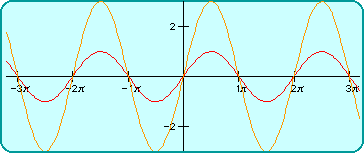
3.
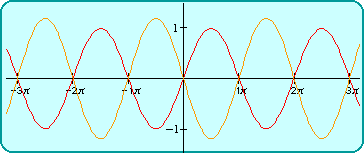
5.

7.

9.

11.

13.
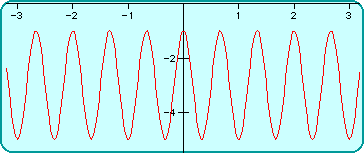
15. f(x) = 1 + sin(2 x) |
17. f(x) = 1.5sin(4 (x 0.25)) |
19. f(x) = 50sin( (x 5)/10) 50 |
21. (a) Maximum sales occurred when t
4.5 (during the first quarter of 1996). Minimum sales occured when t
2.2 (during the third quarter of 1995) and t
6.8 (during the third quarter of 1996). (b) Maximum quarterly revenues were $0.561 billion; minimum quarterly revenues were $0.349 billion. (c) maximum: 0.455 + 0.106 = 0.561; minimum: 0.455
0.106 = 0.349
23. s(t) = 7.5sin(2
(t
9)/12) + 87.5
25. d(t) = 5sin(2
(t
1.625)/13.5)+10
27. (a) u(t) = 2.5sin(2
(t
0.75)) + 7.5 (b) c(t) = 1.04t[2.5sin(2
(t
0.75)) + 7.5
29. Amplitude = 0.106, vertical offset = 0.455, phase shift = 1.16, angular frequency = 1.39, period = 4.95. In 1995 and 1996, quarterly revenue from the sale of computers at Computer City fluctuated in cycles of 4.95 quarters about a baseline of $0.455 billion. Every cycle, quarterly revenue peaked at $0.561 billion ($0.106 above the baseline) and dipped to a low of $0.349 billion. During the second quarter of 1995 (t = 1.16) quarterly revenues were was at the baseline level and on an upward cycle.

![]() | 1. Modeling with the Sine Function | ![]() | 2. The Six Trigonometric Functions | ![]() | Trigonometric Functions Main Page | ![]() | "RealWorld" Page | ![]() | Everything for Calculus |
![]() | Return to Exercises |

![]() | Stefan Waner (matszw@hofstra.edu) | ![]() | Steven R. Costenoble (matsrc@hofstra.edu) |